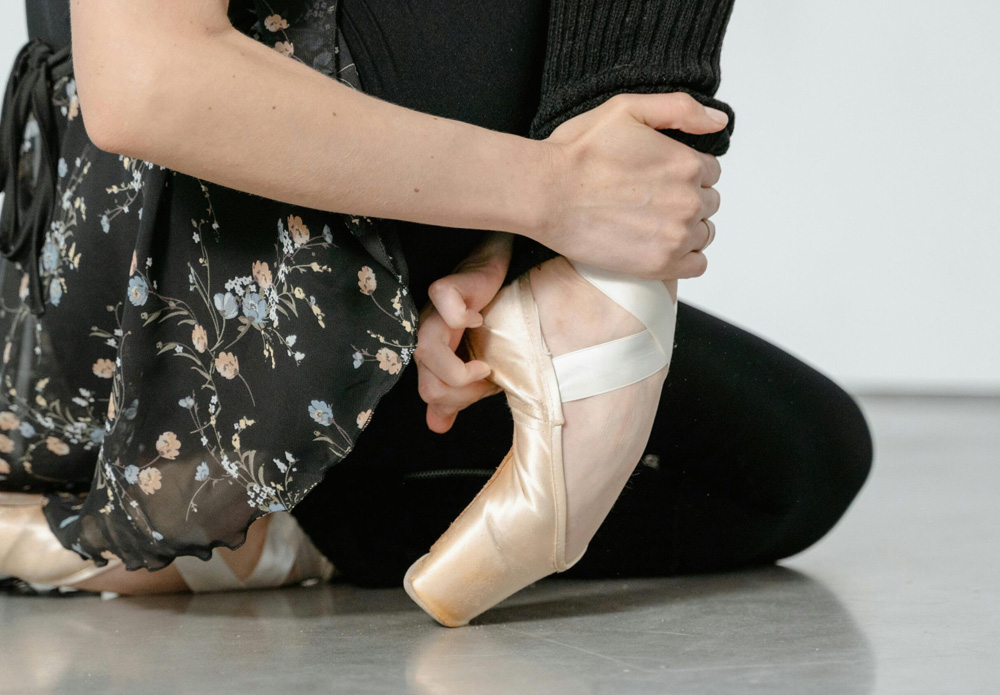
When you prioritise foot articulation – which is how the foot rolls, points, flexes, and supports – you improve not just aesthetics but also control and longevity in your dancing.
Think of it as upgrading the foundation of a building: everything above becomes steadier and more expressive.
Understanding Foot Anatomy for Ballet Dancers
A dancer’s foot is a clever lever system. Three arches – the medial (inside), lateral (outside), and transverse (across the mid-foot) – work together to spring, absorb shock, and stabilise.
Your ankle acts like a hinge to point and flex; the joint just below it allows a gentle roll in or out so you can adapt to the floor without letting the arch collapse. At the front of the foot, the ball and the base of each toe provide the final push into Demi-pointe and pointe.
Think of a tripod: heel, big-toe mound, little-toe mound. Keeping even pressure across those three points improves balance, power, and clean lines. Small foot muscles steer and place the toes, while the calf and other lower‑leg muscles support the arch and guide the ankle.
With this picture in mind, every tendu, relevé, and landing becomes clearer and safer.
Common Foot Mistakes in Ballet
Even advanced dancers fall into habits that can blunt power and clarity:
- Collapsed arches. Dropping the inner arch during pliés, landings, or balances reduces shock absorption and strains the knees.
- Clawing or overextended toes. Gripping at the MTPs – the joints at the base of your toes – to “fake” a point can cramp the arch and limit true line.
- Sickle/wing without control. Aesthetic shaping is fine – until it overrides neutral alignment and stresses the ankle.
- Rushing the roll-through. Skipping demi-pointe in tendus, relevés, and jumps sacrifices both strength and musicality.
- Late or incomplete heel lift. In rises and pirouette preparations, a sluggish heel reduces height and stability.
Spotting these early – and correcting them – protects you from tendon irritation, plantar discomfort, and ankle sprains while instantly sharpening your technique.
Exercises to Strengthen Your Feet
You don’t need equipment to build intelligent, responsive feet. Start with 8–12 reps, 2–3 sets, several times per week.
- Relevés (parallel and first). Rise through the entire foot, press the big-toe mound, and lower slowly – imagine “pouring” the heel back to the floor. Add single-leg sets when you’re consistent.
- Doming (short-foot). Keeping toes relaxed and flat, gently draw the ball of the foot toward the heel to raise the arch. No toe scrunching; the toes stay long.
- Toe tapping (platform or step). Stand tall and place the ball of one foot lightly on a low step. Switch feet rhythmically, tapping just the edge of the step with your toes. Build pace without losing ankle control.
- Theraband plantar/dorsi work (or self‑resisted). Loop a band around the ball of the foot and slowly point/flex against steady resistance – or use your hands to create resistance if a band isn’t available.
- Foot circles and ankle rolls. Seated or supine, draw slow circles with the feet in both directions. Focus on smooth motion from the ankle joint to reduce stiffness and cramping.
- Heel raises (double to single‑leg). Lift the balls of the feet with equal pressure across the big and little toe mounds. Progress to single‑leg when quality is consistent.
- Arch lifts with a towel/ball. Place a towel or small ball under the mid‑foot. Lift the arch by engaging the intrinsic muscles while keeping the toes long; hold briefly, then release..
- Gentle foot stretches. After warming up, point and flex the toes with your hands to mobilise the arches and MTP joints. Hold briefly; avoid forcing range
For a deeper dive into routines and video walkthroughs, see Isabella’s full guide on foot strength and flexibility and the Amazing Feet course. If you’re beginning pointe prep, the Beginner Pointe Course and the Strong Feet Plan give you a clear, progressive pathway.
Techniques for Better Foot Articulation
Good foot articulation in ballet is a conversation between the floor and your centre:
- Point with length, not claws. Initiate from the ankle, then the mid-foot, then the toes. The last joint to move should be the MTPs.
- Flex with clarity. In a flexed foot, keep the ankle aligned and the toes relaxed – not curled.
- Roll through. In tendus and dégagés, feel heel, to mid-foot, to ball, then to toes on the way out, and reverse on the way in. During jumps, land toe – ball – heel with soft knees.
- Press the big-toe mound. This stabilises turnout in relevés and pirouettes and helps prevent sickling.
- Breathe through the transition. Treat each transfer of weight as choreography; the smoother the transition, the cleaner the line.
If you want structured, progressive drills, explore the dedicated Amazing Feet course. To refine stability and control for balances and turns, dip into the Balance Course and support turnout mechanics with the Turnout Course.
Integrating Foot Articulation into Daily Ballet Practice
At the barre. In tendu combinations, slow the tempo and audit your roll-through; in fondu and frappé, track the big-toe mound and arch support. During relevés in first and fifth, keep equal pressure across the tripod of the foot (big toe, little toe, heel).
In the centre. Before pirouettes, feel the heel peel off under control; after turns, lower through demi-pointe without dropping the arch. For Allegro, aim for identical roll-throughs on take-off and landing – no shortcuts when you’re tired.
At home. Pair foot articulation exercises with a short ankle/hip routine. Two smart sets daily beat one marathon session weekly for long-term change. If you’re building toward pointe, follow the Strong Pointe Plan alongside Beginner Pointe Course sessions for structured progression.
Preventing Foot Injuries in Ballet
Prevention comes in the form of technique, timing, and some TLC:
- Warm up well. Start with gentle ankle circles, demi-pliés, and slow rises before class. Cold, rushed feet compensate elsewhere.
- Strengthen progressively. Add single-leg relevés only when double-leg work is consistent. Layer complexity (tempo holds, turnout) after quality is automatic.
- Vary surfaces and footwear wisely. Rehearse on the surface you’ll perform on when possible; check shoes for fit and support. Supportive everyday footwear and, where appropriate, simple foot pads or orthotics can reduce strain when you’re not dancing.
- Recover actively. Alternate mobility work with self-massage around the arch and calf; manage training load across the week. After long training days, a brief ice-foot bath followed later by a warm Epsom-salt soak can help calm irritation.
- Mind alignment. Keep neutral ankle tracking in pliés, landings, and relevés; avoid letting the arch collapse or the heel drift behind you.
- Listen early. Persistent pinch at the big toe, deep ache in the arch, or sharp lateral ankle pain needs attention. A targeted programme like Isabella’s Injury Prevention: Foot & Ankle can help you address patterns before they become problems.
Small Steps Lead to Big Improvements
Every time you articulate the foot – patiently, precisely – you train a better dancer from the ground up. Build strength with simple drills, refine transitions in class, and protect your feet with good habits. In a few weeks, balances feel steadier, jumps sound quieter, and turns set up with less effort. Keep returning to the basics and your lines – and confidence – will grow with every step.