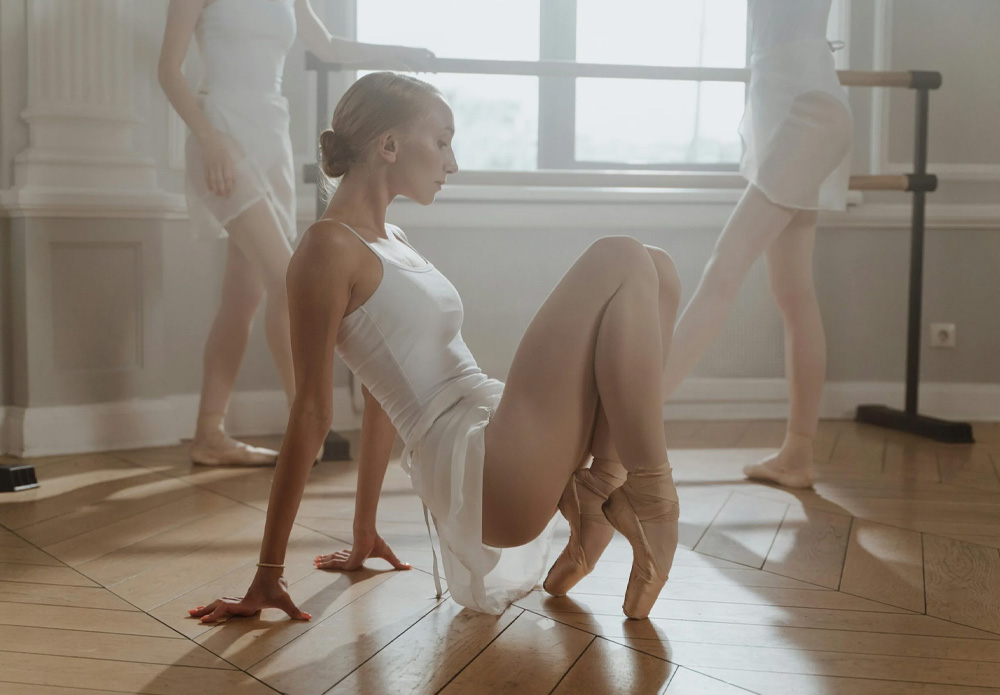
But before you pirouette your way into the studio, there’s a unique language to learn – the language of ballet itself!
This ballet glossary serves as your guide, giving you the definitions of the French and Italian ballet terms that form the foundation of ballet vocabulary.
Glossary of Vaganova Ballet Terms and Movements
The Vaganova method of ballet is a codified system of ballet technique developed in Russia by Agrippina Vaganova. It is one of the most influential and widely used ballet techniques in the world today. The Vaganova method is known for its emphasis on grace, elegance, and musicality.
The Vaganova method is divided into two main parts: the barre exercise and the centre exercise. The barre exercise is a series of exercises that are performed while holding onto a barre. The centre exercise is a series of exercises that are performed in the centre of the room without support.
The Sequence and Significance of the Daily Exercise
The daily ballet exercise is typically divided into three parts: the barre exercise, the centre exercise, and the pointe work (if the student is at an advanced level).
- The barre exercise is designed to warm up the muscles and improve the student’s alignment and balance.
- The centre exercise is designed to develop the student’s strength, flexibility, and coordination.
- Pointe work is designed to develop the student’s balance, strength, and technique on pointe.
The Barre Exercise
The barre exercise is a series of exercises that are performed while holding onto a barre. The barre provides support and stability, which allows the student to focus on proper technique. The barre exercise typically includes the following elements:
- Plié (bending the knees)
- Relevé (rising to demi-pointe or pointe)
- Battements (leg extensions)
- Rond de jambe (leg circles)
- Port de bras (arm movements)
The Centre Exercise
The centre exercise is a series of exercises that are performed in the centre of the room without support. The centre exercise is more challenging than the barre exercise, as it requires the student to use their own balance and coordination. The centre exercise typically includes the following elements:
- Adagio (slow, controlled movements)
- Allegro (fast, lively movements)
- Turns
- Jumps
Adagio
Adagio is a term used to describe slow, controlled movements in ballet. Adagio movements are typically performed with a sense of grace and elegance. Some common adagio exercises include:
- Développé (unfolding the leg)
- Grand jeté (a large, leaping movement)
- Arabesque (a position in which the working leg is extended back and the body is turned to the side)
Allegro
Allegro is a term used to describe fast, lively movements in ballet. Allegro movements are typically performed with a sense of energy and excitement. Some common allegro exercises include:
- Petit jeté (a small, leaping movement)
- Assemblé (a jump in which the feet are brought together in the air)
- Sissonne (a jump in which one leg is extended forward and the other leg is bent behind)
Basic Concepts
The Positions of the Feet
There are five basic positions of the feet in ballet.
- First position: The heels are together, and the toes are pointed outward.
- Second position: The heels are a heel’s width apart, and the toes are pointed outward.
- Third position: The heels are a heel’s width apart, and one foot is in front of the other, with the toes touching.
- Fourth position: The heels are a heel’s width apart, and one foot is in front of the other, with the heels touching.
- Fifth position: The heels are together, and the toes are pointed inward, so that the small toes are touching.
The Positions of the Arms
There are five basic positions of the arms in ballet.
- First position: The arms are held in front of the body, with the elbows bent and the fingertips touching.
- Second position: The arms are held to the sides, with the elbows bent and the fingertips pointing forward.
- Third position: The right arm is held in second position, and the left arm is held in first position.
- Fourth position: The right arm is held in fifth position, and the left arm is held in second position.
- Fifth position: The arms are held overhead, with the elbows bent and the fingertips touching.
The Head and Face
In Vaganova ballet, the head and face should be held in a proud and expressive posture. The chin should be slightly lifted, and the eyes should be focused. The dancer’s expression should reflect the mood of the music and the character they are portraying.
Epaulement
Epaulement is a French term that refers to the way the shoulders are turned in ballet. In Vaganova ballet, epaulement is used to create a sense of line and to connect the upper body with the lower body. There are two main types of epaulement:
- En dehors: The shoulders are turned outward, so that the chest is more open.
- En dedans: The shoulders are turned inward, so that the chest is more closed.
Stability (Aplomb)
Aplomb is a French term that refers to the dancer’s sense of balance and stability. A good dancer should have a strong core and be able to hold themselves upright with ease.
The Concepts en Dehors and en Dedans
- En dehors: This French term means “outward” and refers to the rotation of the legs and feet away from the body’s centre line.
- En dedans: This French term means “inward” and refers to the rotation of the legs and feet towards the body’s centre line.
Plié
Plié is a French term that means “to bend.” In ballet, a plié is a bending of the knees. There are several different types of pliés, including:
- Grand plié: A deep bend in which the heels may rise off the ground.
- Demi-plié: A half bend in which the heels remain on the ground.
- Petit plié: A small bend in which the knees soften slightly.
Relevé
Relevé is a French term that means “to rise.” In ballet, a relevé is a rising onto demi-pointe or pointe.
- Demi-pointe: Rising onto the balls of the feet.
- Pointe: Rising onto the tips of the toes with the weight balanced on the toe box of a pointe shoe.
Battements
Battements are leg extensions that are used to develop strength, flexibility, and coordination. There are many different types of battements, including:
- Battement tendu: A simple extension of the leg to the front, side, or back.
- Battement dégagé: A flicking movement of the leg in which the foot brushes the floor.
- Grand battement: A large, sweeping extension of the leg.
- Petit battement: A small, rapid extension of the leg.
- Battement frappé: A beating movement in which the foot strikes the ankle or the floor.
- Battement fondu: A melting movement in which the leg slides along the floor.
- Battement soutenu: A sustained extension of the leg.
Développé
Développé is a French term that means “developed.” In ballet, a développé is an unfolding of the leg from a plié to a full extension. There are many different types of développés, including:
- Développé à la seconde: A développé to the side.
- Développé devant: A développé to the front.
- Développé derrière: A développé to the back.
- Développé en dehors: A développé with the leg turned outward.
- Développé en dedans: A développé with the leg turned inward.
Rond de Jambe
Rond de jambe is a French term that means “round of the leg.” In ballet, a rond de jambe is a circular movement of the leg. There are two main types of rond de jambe:
- Rond de jambe par terre: A rond de jambe performed on the floor.
- Rond de jambe en l’air: A rond de jambe performed in the air.
Port de Bras
Port de bras is a French term that means “carriage of the arms.” In ballet, a port de bras is a series of arm movements that are used to express the music and the character. There are many different types of ports de bras, but some of the most common include:
- Preparatory port de bras: A simple movement that prepares the arms for another movement.
- Grand port de bras: A large, sweeping arm movement.
- Petit port de bras: A small, delicate arm movement.
Temps Lié
Temps lié is a French term that means “bound time.” In ballet, a temps lié is a series of jumps that are linked together without a break.
The Poses of Classic Ballet
The poses of classic ballet are positions that are held for a moment. There are many different poses, but some of the most common include:
- Arabesque: A pose in which the working leg is extended back and the body is turned to the side.
- Attitude: A pose in which one leg is bent behind the body and the other leg is extended in front.
- Écarté: A pose in which both legs are extended to the side.
Connecting and Auxiliary Movements
Connecting and auxiliary movements are movements that are used to link other movements together. Some common connecting and auxiliary movements include:
- Pas de bourrée: A small, hopping step.
- Pas couru: A running step.
- Coupé: A cutting step in which one foot cuts across the other foot.
- Step: A simple step from one foot to the other.
Jumps
Jumps are movements in which the dancer leaves the ground. There are many different types of jumps, but some of the most common include:
- Temps levé: A small jump from one foot to the other.
- Changement de pieds: A jump in which the feet change positions in the air.
- Pas jeté: A thrown jump in which one leg is extended forward in the air.
- Sissonne: A scissors jump in which one leg opens and closes in the air.
- Saut de basque: A jump with a hop and a turn.
- Pas ciseaux: A jump with legs opening and closing like scissors in a sideward motion.
- Pas ballotté: A rocking jump on one leg.
- Pas chassé: A chasing step in which the feet chase each other.
- Pas glissé: A gliding step in which one foot slides along the floor to the other.
Other Footwork
- Pas failli: A missed step where the landing foot doesn’t quite reach its intended position.
- Pas emboîté: A fitted step where the feet land precisely together.
- Pas balancé: A swaying step.
- Pas de chat: A jump resembling a cat pouncing.
- Gargouillade (Rond de Jambe en l’Air Double): A double rond de jambe en l’air executed quickly.
- Cabriole: A jump with a beat of the legs together in the air.
- Grand fouetté sauté: A large whipped jump with a turn in the air.
Battery
- Petit échappé battu: A small jump with a beat of the feet together in the air.
Preparatory Exercises for Jumps
These exercises help build the strength and coordination needed for complex jumps.
- Preliminary Exercise for Royale and Entrechat-Quatre: Specific exercises to prepare for these jumps.
Entrechats
Entrechats are jumps with multiple changes of the feet in the air.
- Entrechat-Trois: A jump with three changes of the feet.
- Entrechat-Cinq: A jump with five changes of the feet.
- Entrechat-Six: A jump with six changes of the feet.
- Entrechat-Huit: A jump with eight changes of the feet (very difficult).
- Entrechat-Sept: A rarely performed jump with seven changes of the feet.
- Entrechat-Six de Volée: A jump with six changes of the feet performed from a running start.
Turning Movements
These movements involve turning on the balls of the feet (demi-pointe) or on pointe.
- Brisé: A broken turn where the feet alternate between demi-pointe and flat.
- Brisé Dessus-Dessous: A broken turn where the feet alternate positions above and below each other.
- Pas battus: A series of small jumps with turns in between.
Pirouettes
Pirouettes are full turns on one leg.
- Tours on the Floor and in the Air: Turns practised on the floor and then progressed to pirouette.
- Pirouettes at the Barre: Practising pirouettes for stability with the barre’s support.
- Grande Pirouette on Demi-Pointe: A full turn on demi-pointe.
- Grande Pirouette Sautillé (“Hopped”): A pirouette with a small hop at the beginning.
- Tours en l’Air: Turns executed while jumping.
- Tours in the Big Poses: Turns performed while holding poses like arabesque.
Preparation and Turning Techniques
These techniques help initiate and execute turns effectively.
- Préparation and Tour à la Seconde from 2nd Position: Preparing and executing a turn from second position.
- Tours en Dehors in the Big Poses: Turns outward while holding big poses.
- Tours en Dedans in the Big Poses: Turns inward while holding big poses.
- Tours by Various Other Means: Different ways to initiate and execute turns.
Turning Movements Used in Adagio
These turns are incorporated into slow, controlled movements.
- Tours Lents: Slow turns.
- Renversé: A position where the body is arched backwards with one leg extended high behind.
- Grand Fouetté Effacé en Face: A large whipped jump with a turn, facing the audience.
- Grand Fouetté Italien: A large whipped jump with a turn in a specific Italian style.
- Grand Fouetté en Tournant: A large whipped jump with a continuous turn.
- Tour-Fouetté: A combination of a turn and a fouetté (whipped) movement.
Pointe Work
Pointe work is a specialised aspect of ballet that involves dancing on the tips of the toes. It requires exceptional strength, balance, and technique. Pointe work is typically reserved for advanced dancers who have mastered the basics of ballet technique.
Relevé
Relevé is a French term that means “to rise.” In ballet, a relevé is a rising onto demi-pointe or pointe.
- Demi-pointe: Rising onto the balls of the feet.
- Pointe: Rising onto the tips of the toes with the weight balanced on the toe box of a pointe shoe.
Échappé
Échappé is a French term that means “escaped.” In ballet, an échappé is a step where one foot brushes the floor and lands on demi-pointe or pointe.
Glissade
Glissade is a French term that means “gliding.” In ballet, a glissade is a gliding step on demi-pointe or pointe.
Jeté
Jeté is a French term that means “thrown.” In ballet, a jeté is a jump from one demi-pointe or pointe shoe to the other.
Jeté-Fondu (A Soft Step)
Jeté-fondu is a combination of a jeté (thrown jump) and a fondu (melting movement). It is a soft, controlled jump from one demi-pointe or pointe shoe to the other.
Sissonne
Sissonne is a French term that means “scissors.” In ballet, a sissonne is a jump with one leg extended forward and the other leg bent behind, performed on demi-pointe or pointe.
Rond de Jambe en l’Air
Rond de jambe en l’air is a French term that means “round of the leg in the air.” In ballet, a rond de jambe en l’air is a circular movement of the leg in the air, performed on demi-pointe or pointe.
Coupé-Ballonné
Coupé-ballonné is a combination of a coupé (cutting step) and a ballonné (rocking step), performed on demi-pointe or pointe.
Pas Ballonné
Pas ballonné is a French term that means “rocking step.” In ballet, a pas ballonné is a rocking step on demi-pointe or pointe.
Pas de Bourrée Suivi
Pas de bourrée suivi is a sequence of small hopping steps (pas de bourrée), followed by a larger jump or step.
Jumps on Both Legs (Changement de Pieds)
Changement de pieds is a French term that means “change of feet.” In ballet, changement de pieds is a jump where both feet change positions in the air.
Jumps on One Leg
Jumps on one leg are a variety of jumps performed on one leg, such as temps levé, petit jeté, and assemblé.
Tours
Tours are turns on demi-pointe or pointe. They can be performed in various positions and with different speeds and styles.
Tours-Fouettés at 45°
Tours-fouettés at 45° are a combination of turns (tours) and whipping motions (fouettés) performed at a 45-degree angle on demi-pointe or pointe.
Interested in starting ballet?
Join the Ballet with Isabella 8 Week Absolute Beginners Class! You’ll get a strong foundation to the art of ballet in classes of just 5 – 20 minutes per day, led by Isabella McGuire Mayes. A trailblazer, Isabella became the youngest ever British Girl to Join the Vaganova Ballet Academy (at 15!) and graduate. After excelling as a soloist with Mikhailovsky and Eifman Ballet, she returned to London, so you can learn from her!
Unleash Your Inner Dancer: 8-Week Beginner Ballet with Isabella McGuire
Ever dreamed of learning ballet? In this beginner-friendly program, led by the inspiring Isabella McGuire, you’ll gain a strong foundation in the art of ballet – all in just 5-20 minutes a day!
Isabella’s journey is nothing short of extraordinary. A trailblazer in the field, she became the youngest British graduate ever (at just 15 years old!) from the prestigious Vaganova Ballet Academy. After achieving soloist success with Mikhailovsky and Eifman Ballet companies, she returned to London to share her passion for dance with you.
This program is perfect for anyone with no prior experience. You’ll learn the essential building blocks of ballet, including:
- Proper posture and body placement
- Head and arm movements
- Basic ballet positions and arm feels
- How to use the barre for support
- And by the end of the 8 weeks, you’ll be progressing towards mastering a full barre routine!
Join Isabella and discover the joy of ballet!