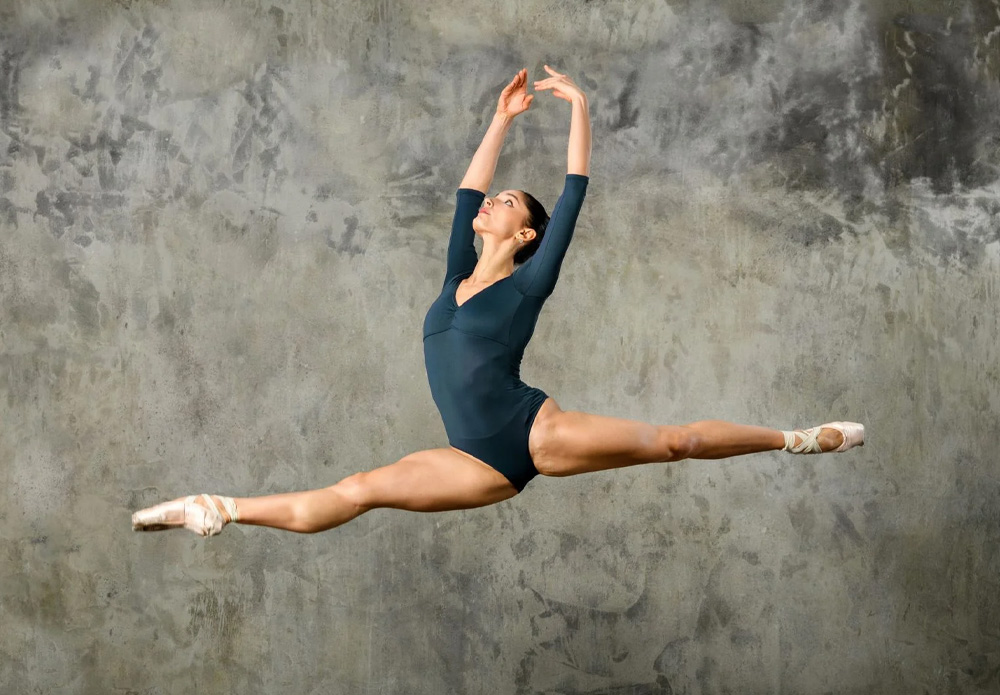
Usually starting this journey from a young age is easier as the muscles are softer, however we can still achieve a good split later in adulthood with dedication and smart practice.
Achieving impressive splits not only enhances your technique but also empowers you to execute fluid movements with elegance and ease. In this article, we will delve into practical tips and effective exercises for beginners upwards to help you improve your splits for ballet and unlock your true potential as a dancer.
What are the splits and why are they important?
The splits, in the context of ballet, refer to a position in which the legs are extended in opposite directions, with one leg positioned in front and the other behind. This is a versatile position, and you will see choreography where dancers do ballet split jumps and ballet splits in the air! This requires a high degree of flexibility in the hip flexors, hamstrings, and inner thigh muscles as well as explosive power. Without both, one would struggle to execute the movement well.
The splits are essential in ballet for several reasons:
- Enhanced lines and extensions: Achieving a full split allows dancers to create beautiful lines and extensions. It elongates the body, showcasing a long and streamlined appearance. This flexibility is especially crucial in movements such as développés and grand battements, where the legs are lifted and extended to their fullest potential.
- Improved mobility and range of motion: By regularly practising the splits, ballet dancers can improve their overall mobility and range of motion. This increased flexibility not only enhances the aesthetic quality of movements but also enables dancers to execute various challenging positions and transitions with ease and grace.
- Graceful leaps and jumps: Splits serve as a foundation for dynamic leaps and jumps in ballet. Movements such as grand jetés and jété en tournant require the ability to split the legs in mid-air, resulting in an impressive display of strength and control
- Agility and balance: Flexibility gained from splits contributes to better balance and agility in ballet. Dancers with well-developed split capabilities can achieve and maintain challenging positions, execute quick turns and pirouettes with stability, and effortlessly shift weight between different movements.
- Artistic expression: The splits offer ballet dancers a broader range of artistic expression. They allow for more creative and visually striking choreography, enabling dancers to explore unique shapes, lines, and partnering movements that captivate audiences and convey emotions effectively.
What wider movements use the splits?
In ballet, splits are not limited to static positions but are incorporated into wider movements, adding depth and complexity to performances. Here are some wider movements that utilise splits:
- Grand Jeté: This iconic ballet movement involves a powerful leap where the dancer extends one leg forward and the other leg backward, often splitting the legs in mid-air. The split position adds an element of grace and showcases the dancer’s control and extension. This online ballet class focuses on developing strong jumps, and is the perfect way to improve this movement.
- Saut de Chat: Also known as the “cat’s jump,” saut de chat is a dynamic leap where the dancer jumps off one leg and splits the legs sideways, resembling a split in mid-air. It requires strength, coordination, and flexibility to execute with elegance and precision.
- Sissonne fermé ouvert or fermé: This step involves jumping from two feet and closing the legs together in the air in a scissor-like movement before landing on one foot. The term “fermé” refers to the closing action of the legs. To execute a sissonne fermé, dancers start with one foot in front of the other, jump forcefully off both feet, and simultaneously bring their legs together in a tight, precise motion. This step requires strength, coordination, and control to maintain proper alignment and a graceful landing.
- Grand jetê en tournant: Also known as entrelacé, this advanced ballet step combines the graceful leap of a grand jeté with a turning motion in the air. As the dancer leaps forward, they execute a full or half turn in the air, landing gracefully on the opposite leg. The key to a successful Grand jeté en tournant lies in the dancer’s ability to generate momentum through the preparatory steps and takeoff, control their body’s rotation in the air, and execute a smooth and controlled landing.
- Penché: This is a forward-bending movement where the dancer extends one leg behind while bending forward from the hips. In more advanced variations, the flexible and strong dancer will achieve a flat split stable position, creating a stunning display of flexibility and balance.
- Jeté manegé: Commonly performed by male dancers, a jeté manegé is a thrilling and challenging ballet step that requires both grace and agility. Also known as a “circular or turning jeté,” this movement involves a series of jetés executed in a circular or semi-circular path. The dancer begins with a preparatory step, then launches into a jeté, propelling themselves off one foot while extending the other leg in a leap. As they land, they quickly transition into another jeté, seamlessly continuing the circular motion. This step demands precise timing, strength, and control to maintain the momentum and flow throughout the sequence.
These wider movements incorporating splits not only require strength and technical skill but also rely heavily on flexibility. By seamlessly integrating splits into these movements, ballet dancers showcase their artistry, strength, and control while captivating audiences with their expressive performances.
What stretches are good to perform them well?
Before diving into split exercises, it is crucial to warm up your body properly. Engage in a warm up routine that involves foam rolling and brings the heart rate up along with a light sweat to increase blood flow to your muscles. Include exercises such as dynamic stretches that target your lower body, such as leg swings, lunges, and hip circles. You can also try out warm up classes designed for ballet at an online studio! A great one to try is the warm-up routine 2.0.
If you’re a beginner, never just dive into splits. It’s something that has to be worked towards slowly and gradually in a safe way. Try these stretches to start with:
- Lunge stretches: Begin in a lunge position with one foot forward and the other behind you. Slowly lower your back knee to the ground while maintaining an upright posture. Feel the stretch in your hip flexors and quadriceps. Repeat on both sides.
- Straddle stretches: Sit on the floor with your legs spread wide into a straddle position. Slowly lean forward, keeping your back straight, and reach for your feet or ankles. Hold this stretch for 20-30 seconds, feeling the stretch in your inner thighs. Repeat several times.
- Hamstring stretches: Sit on the floor with one leg extended in front of you and the other leg bent. Lean forward from your hips, reaching toward your extended leg while keeping your back straight. You should feel a gentle stretch in your hamstrings. Repeat on both sides.
- Prop-assisted stretching: Using props can aid in achieving deeper splits gradually and safely. You can place yoga blocks under your hands for support as you lower into the splits. Gradually decrease the height of the blocks as your flexibility improves. You can also loop a resistance band around your back foot and gently pull it towards you while in a split position. This helps intensify the stretch and increase flexibility.
Stretching with the right intensity and technique is key, and it’s often much easier when you have an expertly guided class to assist you. Try out this online studio class on long hamstring stretches or hip and mobility stretches to get the most out of your workout!
What to remember when you are working on your splits
Consistency is key when working on your splits. Aim to stretch for at least 15-20 minutes, three to four times per week. Regular practice will yield better results compared to infrequent, intense sessions!
During split stretches, it’s essential to stay relaxed and maintain steady, deep breathing. Tension in your muscles can hinder progress. Focus on releasing any unnecessary tension and take slow, deep breaths to help you relax into the stretch.
Remember to avoid pushing your body beyond its limits. Gradually increase the depth of your splits over time, respecting your body’s natural range of motion. Pushing too hard too soon can lead to injuries. Listen to your body and know when to take breaks or modify stretches if necessary.
Join an expert-led online ballet studio, designed for beginners and advanced dancers!
Improving your splits for ballet is an ongoing journey that requires dedication, patience, and consistent effort. To help you on your journey, it’s a great idea to join the Ballet with Isabella online ballet studio!
Designed for dancers at all levels, there are a wide range of classes ranging from HIT and core workouts to specific poses and movements, such as the splits. The studio is led by Isabella McGuire Mayes, the first British graduate of The Vaganova Ballet Academy and soloist of The Mikhailovsky Ballet, and in addition to online classes, you can enjoy courses, private lessons, and in-person workshops and coaching sessions.
Isabella used to be told she didn’t have enough flexibility and with her steady stretching efforts and smart training she went on to have lasting results and some of the highest legs at the vaganova school.
Together, wherever you are in the world, we can embrace the process, celebrate each milestone, and enjoy the transformation as you unleash grace through your new split skills.