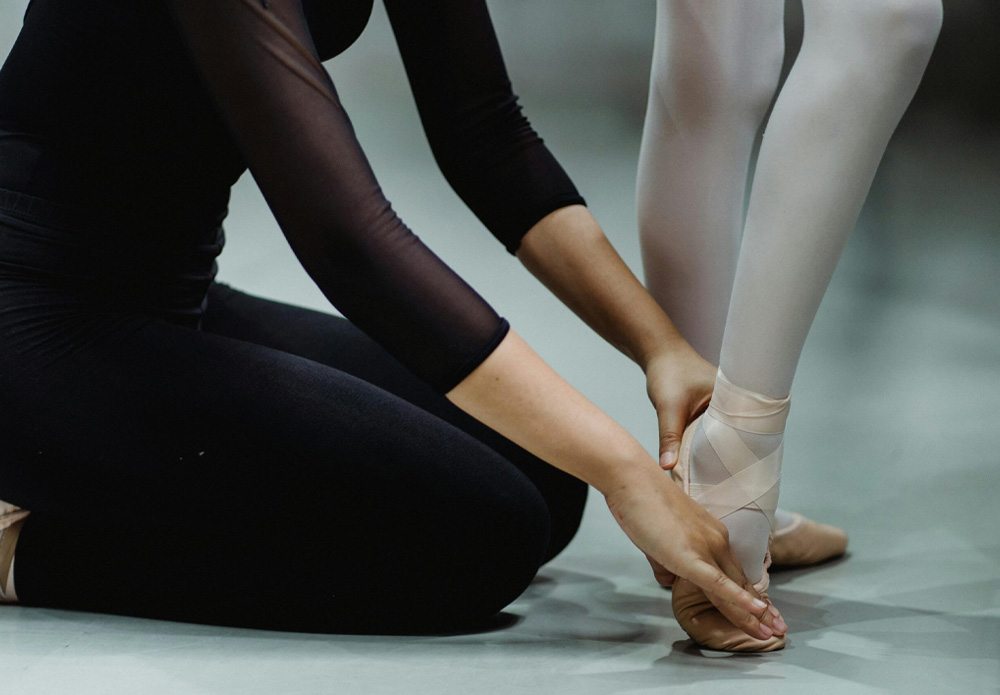
The Role of Alignment in Ballet Technique
Ballet posture alignment isn’t about looking stiff or “perfect” – it’s about stacking your body so your muscles can do their jobs efficiently.
When your head, ribcage, pelvis, knees, and feet line up well, you’ll find balance more quickly, use less effort to stay lifted, and move with clearer, cleaner lines. Even better: good ballet body alignment reduces unnecessary strain on joints and tissues, which is a big deal for longevity (and for keeping class feeling enjoyable instead of painful).
Let’s look at the most common alignment mistakes dancers make – and how to start fixing them in a way that supports you, rather than overwhelms you.
Common Alignment Mistakes in Ballet
1) Rounded shoulders and “collapsed” upper back
Rounded shoulders often come from trying to “hold” the arms forward, or from everyday posture (hello, laptops and phones). The result is a heavy chest, tense neck, and arms that feel harder to coordinate.
Fix it: Think of widening across your collarbones. Let your shoulder blades sit flat and slightly down, without pinching.
2) Rib flare
When the ribs pop forward, the lower back usually arches to compensate. You might feel lifted, but it’s often a false lift that steals stability.
Fix it: Exhale gently and imagine your ribs knitting towards your centre. Keep the sternum buoyant, not pushed.
3) Misaligned hips (tilted, twisted, or “hiking”)
A lifted hip (especially in arabesque or developpé) is incredibly common. So is a pelvis that tips forward or back, which changes how turnout and core support work.
Fix it: Use a mirror occasionally, but also practise feeling your hip points facing forward like two headlights.
4) Over-rotated turnout and knees not tracking over toes
Forcing turnout from the knees or feet (instead of the hips) can lead to rolling arches, sickling, and knee discomfort.
Fix it: Choose turnout you can maintain with the feet tripod grounded (big toe mound, little toe mound, heel).
5) Collapsed arches and rolling in
If your arches drop in plié or relevé, the ankles and knees lose their best support line.
Fix it: Keep weight balanced across the whole foot and practise “lifting” the arch without gripping the toes.
How Alignment Affects Performance and Injury Risk
Alignment doesn’t just change how you look – it changes what your body can do.
- Unstable turns: If your ribs flare, your standing hip shifts, or your foot rolls in, your centre of mass drifts. That’s why pirouettes feel like they’re slipping away rather than landing neatly.
- Knee strain: Knees that don’t track over toes in plié (especially with forced turnout) can create repeated stress through the joint.
- Ankle sprains and foot pain: Rolling in, sickling, and collapsed arches make the ankle less steady, particularly in jumps and quick changes of direction.
- Lower back tension: Rib flare plus an arched lower back can overload the lumbar spine – especially when you’re working extensions or backbends.
The good news: once you improve the way your body stacks, you often feel an immediate difference in control. It’s one of the fastest ways to start improving ballet technique without adding more hours of training.
Correcting Posture at the Barre
The barre is your alignment laboratory: slower tempo, lots of repetition, and built-in feedback.
Try this “stack check” before you start
- Feet in a comfortable first position.
- Imagine your head floating up, chin level.
- Ribs soft, pelvis neutral (not tucked hard, not arched).
- Knees tracking over the second toe in plié.
- Tripod foot grounded.
Helpful barre cues and mini-exercises
- Shoulder blade slides: With one hand lightly on the barre, slide the shoulder blade down and wide, then let it relax. You’re teaching the shoulder to sit, not to squeeze.
- Pliés with knee tracking: Watch that the kneecaps follow the toes (especially in second position). If your arches drop, reduce turnout slightly.
- Slow relevés: Rise to demi-pointe as if you’re zipping up through the inner thighs and lengthening through the crown of the head.
If you’re working towards pointe (or already on pointe), barre alignment becomes even more important. This class is a lovely option to practise placement with support: Beginner Pointe Barre.
Centre Work Alignment Tips
Centre work adds momentum, nerves, and the temptation to “grab” for stability. Keep your focus on a few simple anchors.
Turns
- Stand on your best foot: Before you turn, feel the tripod foot and a lifted arch.
- Passé placement: Bring the working foot to the knee without shifting the standing hip sideways.
- Spot without the neck tension: The head turns quickly, but the neck stays long and easy.
Jumps
- Land through the whole foot: Think toe-ball-heel (or ball-heel) with the knees tracking over toes.
- Quiet ribs: If the ribs flare on take-off, you’ll often feel a “snap” in the lower back.
Balances and extensions
With développés and side lines, the biggest giveaway is usually the hip lifting or the standing leg collapsing.
A great way to refine this is to slow down and practise the pathway, rather than the final height. If you’re working on side lines, this breakdown is especially useful: Side Developpé.
Strengthening Muscles That Support Alignment
Alignment is a skill – but it’s also a strength problem. These areas matter most:
- Core (deep support): dead bugs, heel taps, slow roll-downs.
- Back (upright posture): bird dogs, prone “swimmers”, scapular retractions.
- Glutes and turnout support: clamshells, side-lying leg lifts, glute bridges.
- Lower legs and feet: slow calf raises, theraband ankle work, foot doming.
If you want a full plan that builds strength in a dancer-friendly way (without turning into a gym slog), you can follow along with The Ultimate Ballet Workout Guide: From Beginner to Advanced Training.
Daily Habits to Maintain Proper Alignment
Alignment isn’t only a “class thing”. Your body learns what you repeat.
- Do micro posture checks: Waiting for the kettle to boil? Stack your ribs over pelvis and soften your shoulders.
- Warm up with intention: A few slow pliés, ankle circles, and gentle core engagement can wake up the right support.
- Stretch, but don’t collapse: When you stretch, keep the joints organised – especially knees over toes and a long spine.
- Build body awareness: Film a short combo occasionally. You’ll spot patterns you can’t always feel in the moment.
Small, consistent adjustments beat one big “perfect posture” effort that lasts five minutes.
Alignment as the Foundation of Beautiful Ballet
When alignment is working for you, everything else gets easier: balances feel calmer, turns feel more predictable, and your legs and feet can show their strength without fighting your joints. Keep returning to the basics of ballet posture alignment and ballet body alignment, especially at the barre – and let that carry into the centre.Over time, these tiny corrections add up to a technique that looks cleaner, feels stronger, and supports you for the long run – which is exactly what we want when we’re focused on improving ballet technique.