The menstrual cycle is one of the big myths in the dance world.
Dancers are sometimes praised for delayed maturation (=delayed puberty); they’re told that this will help them achieve the ‘ideal ballet body’, and are also praised for either not getting their periods in the first place, or losing them again after while. And all of this…is not okay to say to dancers.
The menstrual cycle, and associated with that the monthly period, are an important marker of health, performance, and adaptation to training for dancers. So, why are young dancers all over the world being told they don’t need it? And why do they believe it?
First of all, society has made talking about the menstrual cycle or periods (they’re not the same!) something of a taboo. Although, in recent years barriers are being broken down as it becomes normalised, and that’s good news. However, the bulk of communication still focuses on the cycle being important for reproductive health – which it is – but stops short of reporting about how it can influence the ability to adapt to training, and that it’s connected to cardiovascular health, brain health and mental health.
So, let’s quickly recap the menstrual cycle:
- They should start age 15/16 at the latest.
- After the first ever period (‘menarche’), a mostly regular cycle should occur (it can initially be up to 45 days long, but this isn’t too common).
- The average duration for the cycle is 28 days, however, it can last anywhere from 21 to 35 days. Ovulation (the release of an egg cell from a follicle in the ovaries) occurs mid-cycle. The phase before ovulation is called follicular phase, the phase afterwards is called luteal phase.
- There are 4 key hormones involved, the most well known being estrogen and progesterone, but LH (luteinizing hormone) and FSH (follicle stimulating hormone) play important roles as well. These 4 hormones show varying levels (‘cycling’) during a normal menstrual cycle (Fig 1).
- The actual period, the bleeding, is the beginning of a new cycle, and can last anywhere between 3-5 days; the average menstrual loss is 30-60ml.
- A period can be accompanied by feeling not so well, or experiencing some sort of pain (that usually eases off with some gentle movement). However debilitating pain (e.g. requiring constant pain medication) needs to be checked, as conditions like endometriosis are often overlooked, and awareness has been raised that this occurs more often than previously thought.
- Less than 9 periods per calendar year are called oligomenorrhea, whereas no cycle at all for >6 months is called secondary amenorrhea. No menstrual cycle and you’re older than 16? That’s called primary amenorrhea.
Alright, and what does the menstrual cycle do for dancers’ health?
- Besides being connected to reproductive health, it plays a huge role in bone health. Estrogen is a must for healthy and strong bones (bones really have an estrogen-receptor); and without a cycle, there is no estrogen, which in turn affects the bones negatively. Stress fractures are a typical sign.
- The human brain has a lot of estrogen receptors as well. So what happens if estrogen levels are low/very low/almost non-existent? Estrogen plays a huge role in cognition (e.g. learning a new syllabus or choreography, memorizing corrections) and also mood. No period – no estrogen – not feeling as happy as you used to. It can also present as anxiety.
- While our heart pumps all the blood (and with it the oxygen we need for intense training), a network of arteries and veins distributes the blood to the places where it is needed. Estrogen makes blood vessels more pliable, meaning you can tolerate the stop-and-go nature of dance much better. Low estrogen levels require the heart to beat faster and harder to distribute blood, oxygen and nutrients from food, meaning you will fatigue much earlier.
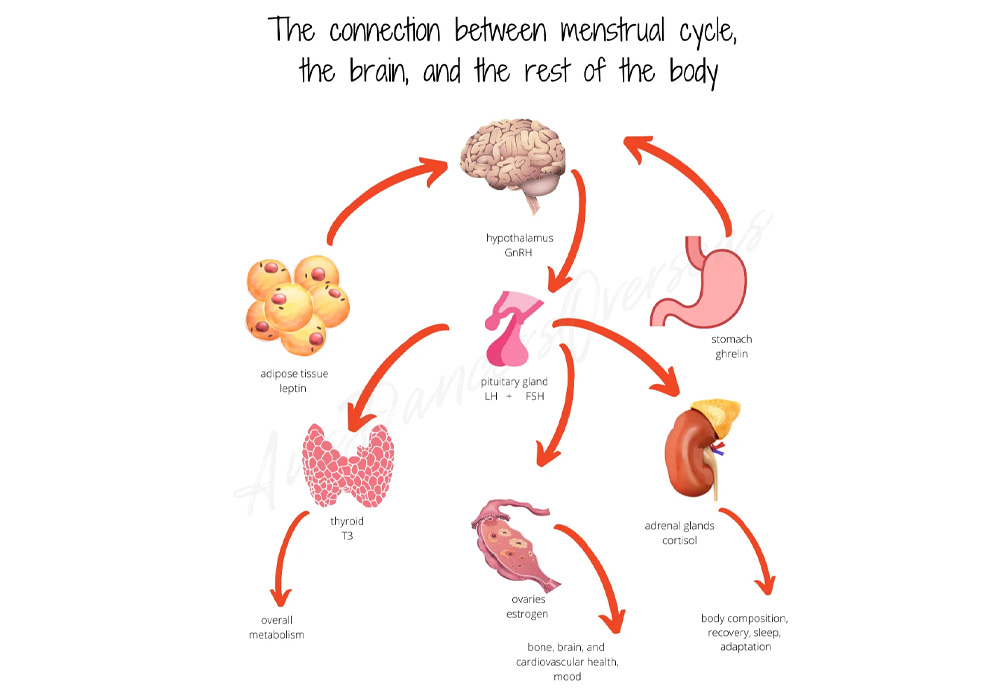
- What mainstream media rarely talks about is that the cycle actually starts off in the brain (the hypothalamus where GnRH, another hormone is secreted). This hormone is quite sensitive to disruptions (see below) and in turn not only influences your cycle, but also other hormones that you need to adapt to your dance training and become a better and stronger dancer (growth hormone is one, for example). LH and FSH are also secreted in the brain (in the pituitary gland), and that’s most often a shock for dancers – like, how can the brain play a role in my cycle? It absolutely can! And it does.
With that being said, how is it possible to lose one’s period at all, considering how important it is for the body?
The human body perceives 3 behaviors as potentially life-threatening.
- Overexercising (intentionally or unintentionally).
- Undereating (not eating enough to support training as well as all life processes).
- Stress. There are different types of stress, some being beneficial (eu-stress), but a lot isn’t beneficial for the body (e.g. constantly criticizing yourself, not showing yourself some self-love, not taking care of your body, stressing over a teacher’s comment in class, being told you ‘don’t look the part’). Overexercising and undereating are both stressors in themselves, although they have a multitude of other negative effects as well.
When any of these factors, two, or maybe all three of them (which is typical for dance) occur, your body thinks it must protect you from this threat. As it can’t know how long this threat will last, it will switch off a couple of processes that you don’t need for immediate survival (Fig 2a and 2b). Whilst this is smart – it’s also where the narrative goes wrong: Just because your body doesn’t need these processes for immediate survival, it doesn’t mean there are no health consequences for going without them for either a short – or a long time. So, telling a dancer it’s a good sign they don’t have their period is as far from the truth as it can get.
What are the effects of no cycles on health?
- Peak bone mass won’t be achieved. Many dancers have a lower than expected bone density, and osteopenia (low bone mineral density) is a common diagnosis in dancers; so is osteoporosis (very low bone mineral density), but its prevalence is a tad lower. These bones fracture much earlier than healthy bones (incl. stress fractures).
- Immune system: Frequent infections or wounds that aren’t healing well are common signs that the immune system isn’t as strong as it could be, this is particularly true if under-eating is the cause.
- Gastrointestinal problems: What many dancers believe are food intolerances are most often a sign that the gut cannot function properly – again, most often due to under-eating.
- Hormonal issues: As discussed for growth hormone, you’re likely to plateau in your training/performance ability, and instead of putting in extra hours, finding the root cause helps a lot more!
- Metabolic issues: The cortisol (stress hormone) levels produced by your adrenal glands are through the roof, but your thyroid hormone is as low as it can get? These are typical side effects when overexercising, under-eating, or stress (or all 3 of them) dominate your day.
- Growth and development: Puberty will eventually catch up with any dancer, no matter how much they try to delay it, and most often it hits them during graduation year – when dancers find themselves off balance, having trouble with their proprioception, extensions and/or flexibility.
- Hematological issues: Deranged blood parameters are common. This does not only affect hormones but also nutrients like iron or B-vitamins.
And what are the effects on training and performance?
- Increased risk of injury (fractures, but also muscle/soft tissue injuries)
- Decreased training response (plateauing or regressing in training)
- Decreased coordination (it is so crucial in dance to have excellent coordination)
- Decreased muscle strength and endurance (very often due to insufficient intake of both carbohydrates and protein, but also no rest days)
- Decreased concentration (learning a difficult new move or choreography just got a bit harder….)
- Impaired judgement (the human brain is very sensitive to stress and under-eating – making smart decisions while not providing enough energy to think clearly? Right, that’s not happening.)
- Depression/anxiety: Both conditions have long been considered to be of psychological origin only, but physical and mental causes are more intertwined than we can even begin to imagine. For example, starting from the underfueled gut causing you symptoms, the next step that not enough of a specific amino acid (tryptophan) is being produced by gut bacteria, hence why only low levels are transported to the brain. That is important because tryptophan is the precursor of the happy hormone serotonin, and if there isn’t much tryptophan …. you guessed it right. Furthermore, serotonin is the precursor of our sleep hormone melatonin – which in turn is the reason that underfueled dancers often don’t sleep well. Not sleeping well can cause us to be more anxious; feeling low … there you go.
Last but not least, why do we need to talk about this topic at all?
For more than 40 years, the prevalence of amenorrhea in dancers has been researched – yet the translation into current, daily life lags behind. It is not the purpose of this article to discuss the reasons for that, but to raise awareness that many, many health issues in female dancers arise because they were never taught how to read the signs of their body, not to mention the myths they were made to believe. The study (Keay N, AusDancersOverseas, Francis G, 2020) revealed that out of a population of <200 female dancers (mostly ballet students and professional ballet dancers), only 50% had regular menstrual cycles. Having read the article here, you now know that this is alarming.
This article is meant to empower you, to enable you to check-in with your behaviors, and if you find yourself having one or more symptoms of oligo- or amenorrhea, please seek the support of a qualified healthcare professional to get on top of this health issue that affects your performance as well.
Further reading:
Overall concept of low energy availability as defined by the International Olympic Committee (IOC): Mountjoy M et al. (2018). IOC consensus statement on relative energy deficiency in sport (RED-S): 2018 update. Br J Sports Med, 52(11):687-697. doi: 10.1136/bjsports-2018-099193.
Keay N, AusDancersOverseas, Francis G (2020). Indicators and correlates of low energy availability in male and female dancers. BMJ Open Sport Exerc Med, Nov 26;6(1):e000906. doi: 10.1136/bmjsem-2020-000906
Mitchell SB, Haase AM, Malina RM, Cumming SP (2016). The role of puberty in the making and breaking of young ballet dancers: Perspectives of Dance Teachers. J Adolesc, 47:81-9. doi: 10.1016/j.adolescence.2015.12.007
Mitchell SB, Haase AM, Cumming SP (2020). Experiences of delayed maturation in female vocational ballet students: An interpretative phenomenological analysis. J Adolesc, 80: 233-241. https://doi.org/10.1016/j.adolescence.2020.03.005
Areta JL, Taylor HL, Koehler K (2021). Low energy availability: history, definition and evidence of its endocrine, metabolic and physiological effects in prospective studies in females and males. Eur J App Physiol, 2021 Jan;121(1):1-21. doi: 10.1007/s00421-020-04516-0. Epub 2020 Oct 23.